
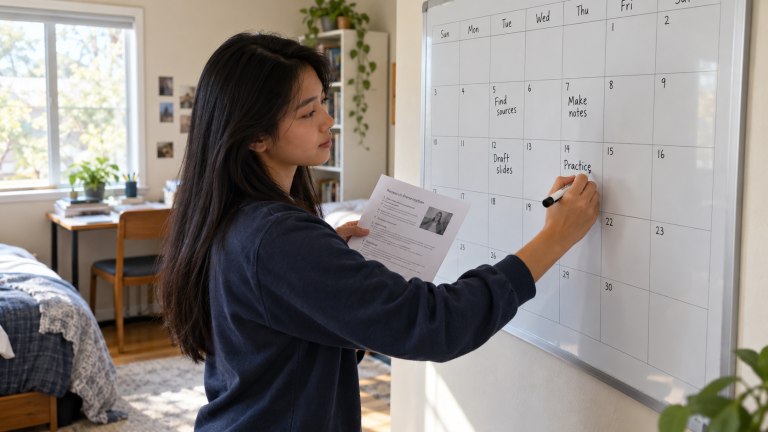
A planner contains all the deadlines. The history project is due Friday, the science quiz is Wednesday, and the reading response needs to be submitted tomorrow.
The student looks at the page but still does not know what to do first.
Recording deadlines is useful. Students also need to identify the work behind those dates and decide when they can do it.
Weekly planning for students works best when deadlines are connected to specific actions and realistic work sessions.
At Classically Modern Teaching, I help students build planning routines around actual assignments and available time. A weekly plan should give them a clearer next action and a way to adjust when circumstances change.
It begins with a short meeting the student can help lead.
Gather the information in one place
Before making the plan, collect the materials it depends on.
Open the school portal. Bring out the planner. Check assignment instructions, assessment dates, activities, and family commitments.
Ask the student to enter or explain the information.
A parent can help identify missing pieces:
“Does that date mean the whole project is due, or is it an intermediate checkpoint?”
“Do you have the instructions for that assignment?”
“Is there anything you need to ask your teacher?”
Clarify uncertainty before building the schedule around an assumption.
The student does not need an elaborate system. Start with a place they can find and return to consistently.
Put fixed commitments on the calendar
Start with school, activities, appointments, work, travel, and other commitments with defined times.
Then look at the remaining space realistically.
A student arriving home late from practice has a different evening available from a student with an open afternoon. A family event may make the weekend less flexible than it appears.
Include time for ordinary needs and rest. A plan that fills every available minute leaves little room to respond when a task is difficult, or something changes.
Ask the student:
“Where is there actually room to work?”
That question turns a list of intentions into a conversation about choices.
Translate assignments into actions
“Finish history project” names an outcome. It leaves the first steps unclear.
Read the instructions together and identify the actions involved.
For a research presentation, the student might need to:
- Choose a focused question.
- Locate and examine sources.
- Make notes.
- Decide on the main point.
- Organize the presentation.
- Create slides.
- Practice.
- Check and submit the required files.
Some actions depend on earlier ones. The student cannot select the strongest evidence before examining the sources.
Ask them to explain the sequence and identify the first action they can complete.
Define what finished means
A vague work session can end without the student knowing whether they made useful progress.
Compare these two plans:
“Work on research.”
“Read the first source and create two notes that include the source details and an explanation of relevance.”
The second plan gives the student a visible stopping point.
It also makes review easier. If the work remains unfinished, they can describe what happened: the source was inaccessible, the reading was more difficult than expected, or the question needed clarification.
The next step can respond to that specific obstacle.
Estimate time and leave room to learn
Students may have limited experience estimating unfamiliar tasks.
Ask for a reasonable starting estimate, then treat it as something to review.
Suppose the student plans a half-hour session to find two suitable sources. Afterward, they have found several possibilities but have not examined them closely enough to choose.
The useful conversation is about what the task actually required.
Did the student’s estimate include reading and evaluation? Were the search terms too broad? Was the topic unfamiliar?
Use the answer to adjust the next session.
The plan becomes more useful as the student learns what different kinds of work involve.
Try a small weekly plan
Imagine a presentation is due Friday.
A student might propose:
Monday: Read the instructions, clarify the question, and identify possible sources.
Tuesday: Examine the sources and make notes.
Wednesday: Organize the main points and draft the slides.
Thursday: Check evidence, revise, and practice.
Friday: Complete the final check and submit.
This is an example to adapt. A larger project would need more time, and the student’s actual commitments may require a different arrangement.
Ask the student to explain why the proposed sessions are realistic. Check whether the assignment includes requirements the plan has missed.
End each session with a next step
Before putting the work away, record what happened.
What was completed? What remains? Is there a question to ask or a material to obtain?
Write the next action clearly enough that the student can begin without reconstructing the whole project.
“Continue presentation” offers little guidance.
“Add the source information to slides three and four, then practice explaining the second example” creates a clearer starting point.
A brief closing routine can also include checking whether the student has submitted or packed their work.
Give parents a defined role
A weekly check-in gives parents a place to offer support without turning every conversation into a deadline reminder.
The student can open the calendar, explain priorities, and identify where they need help. The parent can ask questions, clarify family commitments, and help arrange appropriate assistance.
Some students will need frequent guidance, explicit modeling, or established accommodations. Build those supports into the plan.
Then review which responsibilities the student can practice taking on.
Ownership can begin with a small action, such as recording assignments or leading the end-of-week review.
Review the week before planning the next one
Ask three questions:
What worked?
What changed?
What should we try differently?
Choose one adjustment. Perhaps source evaluation needs more time, Thursday evenings are too crowded, or the first action needs to be smaller.
At Classically Modern Teaching, I want students to understand how their plans connect to the work they actually do.
A useful routine gives them repeated practice making decisions, noticing obstacles, and adjusting with purpose.
Make the work visible. Choose the next action. Review and adjust.
Join the Classically Modern Teaching newsletter
Practical ideas for students, parents, and educators, plus news about classes and free webinars.