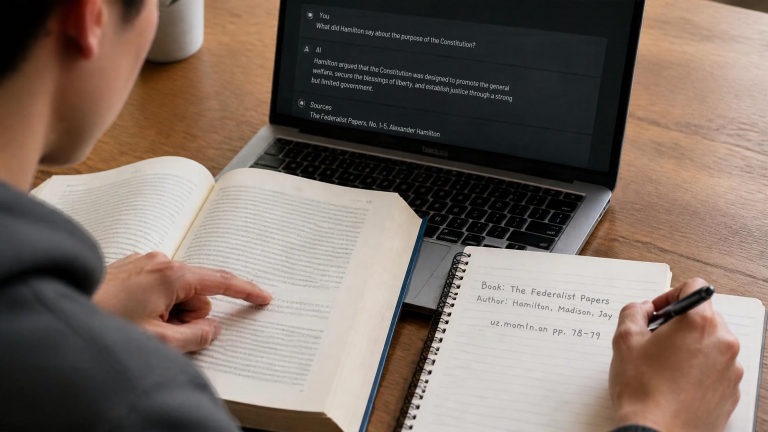
Imagine a student researching a history paper. An AI tool provides a useful-looking explanation, complete with a quotation and a book citation. The author’s name sounds familiar. The title fits the topic. The quotation perfectly supports the student’s argument.
Then the student searches for the book and cannot find it. The student also cannot locate the quotation.
This is an example of an AI hallucination: a response that presents inaccurate or invented information as though it were factual. The National Institute of Standards and Technology also calls this problem confabulation and identifies confidently stated false content as a risk of generative AI. Recognizing these errors is an important part of AI literacy.
For students, the practical lesson is straightforward: confidence is not evidence.
What do AI hallucinations look like?
An unreliable response may contain an invented quotation, an incorrect date, a nonexistent source, or a description that misrepresents the material it claims to summarize. It can also combine accurate information with fabricated details, making the problem harder to notice. NIST documents these kinds of errors, including fabricated citations and explanations that appear to justify incorrect answers, in its Generative AI Profile.
Consider these hypothetical examples:
- A literature response attributes a convincing quotation to a character who never says it.
- A research assistant lists an article with a plausible title and publication date, but the article does not exist.
- An explanation accurately describes a historical event, then adds an unsupported claim about why someone acted.
- A summary of an uploaded reading introduces a detail that never appears in the original.
Students need to examine the claims within an answer. A response that gets several things right still needs checking.
Why a polished answer can be misleading
Students are accustomed to using features such as clear organization, precise vocabulary, and complete citations as signs of careful work. An AI response can show all those features while still containing errors.
The underlying issue is that generating plausible language does not guarantee factual accuracy. NIST explains that language models generate text using learned statistical patterns and can produce false content through that process. A response’s tone does not reliably reveal whether its claims are supported.
This makes careful reading especially important. Students should learn to pause at specific claims and ask, “What evidence supports this?”
That question is useful whether the information comes from AI, a website, a video, or a conversation.
A citation is an invitation to investigate
A reference at the end of a paragraph may look reassuring. Students still need to follow it.
There are two separate questions to answer:
Does the source exist?
Search for the title and author through a library catalog, the publisher’s website, an academic database, or another appropriate resource. Check that the details match.
Does the source support the claim?
Open and read the relevant material. A real article can be cited for something it never says. A quotation can be altered, or a summary can omit an important qualification.
For example, a student might find that an article describes a possible explanation, while the AI response presents it as an established fact. The source exists, but the response has overstated its conclusion.
Students need to understand the evidence well enough to use it accurately.
A practical checking routine for students
Verification becomes more manageable when students have a repeatable process.
1. Identify what needs checking
Mark quotations, dates, statistics, names, citations, and claims that carry the argument. If removing a statement would weaken the conclusion, that statement deserves attention.
2. Choose a suitable source
Match the source to the question. Check an application requirement on the college’s official website. Check a literary quotation in the text itself. Investigate a research claim through the original study when possible, with help interpreting it when needed.
3. Read beyond the matching words
Finding the same phrase is only the beginning. Read enough surrounding material to understand its meaning, limitations, and context.
4. Correct or remove unsupported material
If a claim cannot be verified, leave it out until you have adequate evidence. Rewriting it in your own words does not solve the problem.
5. Keep a record
Save the source details and note where the supporting evidence appears. That makes it easier to cite accurately, revisit a question, and explain your reasoning.
This process takes effort. That effort is part of learning to research.
Asking AI to check itself is only a starting point
A follow-up prompt such as “Are you sure?” can encourage another response, but it does not provide independent evidence.
Students can use follow-up questions to identify what to investigate: “Which source supports that date?” or “Where does this quotation appear?” They then need to open the source and check it themselves.
Agreement from another chatbot also leaves the student with the same essential task: locate reliable evidence and examine it.
How parents can support the habit
Parents can help by showing interest in how students reached an answer.
Try asking:
- “Can you show me where that information came from?”
- “Did you find the quotation in the original text?”
- “What did you change after checking?”
- “Is there anything you’re still unsure about?”
These questions make verification a normal part of academic work. Discovering an error becomes an opportunity to practice good judgment and improve the result.
It also helps students become comfortable saying, “I haven’t confirmed that yet.” Recognizing uncertainty is a useful research skill.
Careful thinking gives tools their value
At Classically Modern Teaching, I teach students to approach AI responses with curiosity and a process for checking what they find.
Close reading helps them notice a mismatch. Subject knowledge helps them question an unlikely detail. Research skills help them locate evidence. Writing helps them explain what that evidence supports.
These academic foundations give students the means to use modern tools thoughtfully.
Think first. Ask second. Verify third.