Thoughtful AI use. Stronger teaching.
Classically Modern Teaching helps educators use AI thoughtfully while strengthening academic rigor, independent thinking, and student authorship.
Led by Deanna Heikkinen, EdD, services include practical educator workshops, curriculum consultation, and support for integrating AI into teaching and learning.
Modern tools. Human thinking.
Professional learning should do more than introduce new technology. It should help educators decide when a tool supports learning, when it gets in the way, and how to preserve the intellectual work students still need to do.
Start with the educational problem, not the technology.
AI creates new possibilities for teaching, planning, research, and feedback, but it also raises important questions about authorship, academic integrity, verification, and student thinking.
These workshops begin with the work educators already do. Participants examine real instructional challenges, explore practical uses of generative AI, and leave with approaches they can adapt to their own classrooms, courses, or programs.
Practical professional learning for a changing classroom.
Workshops are designed around real instructional questions and practical strategies educators can use immediately.
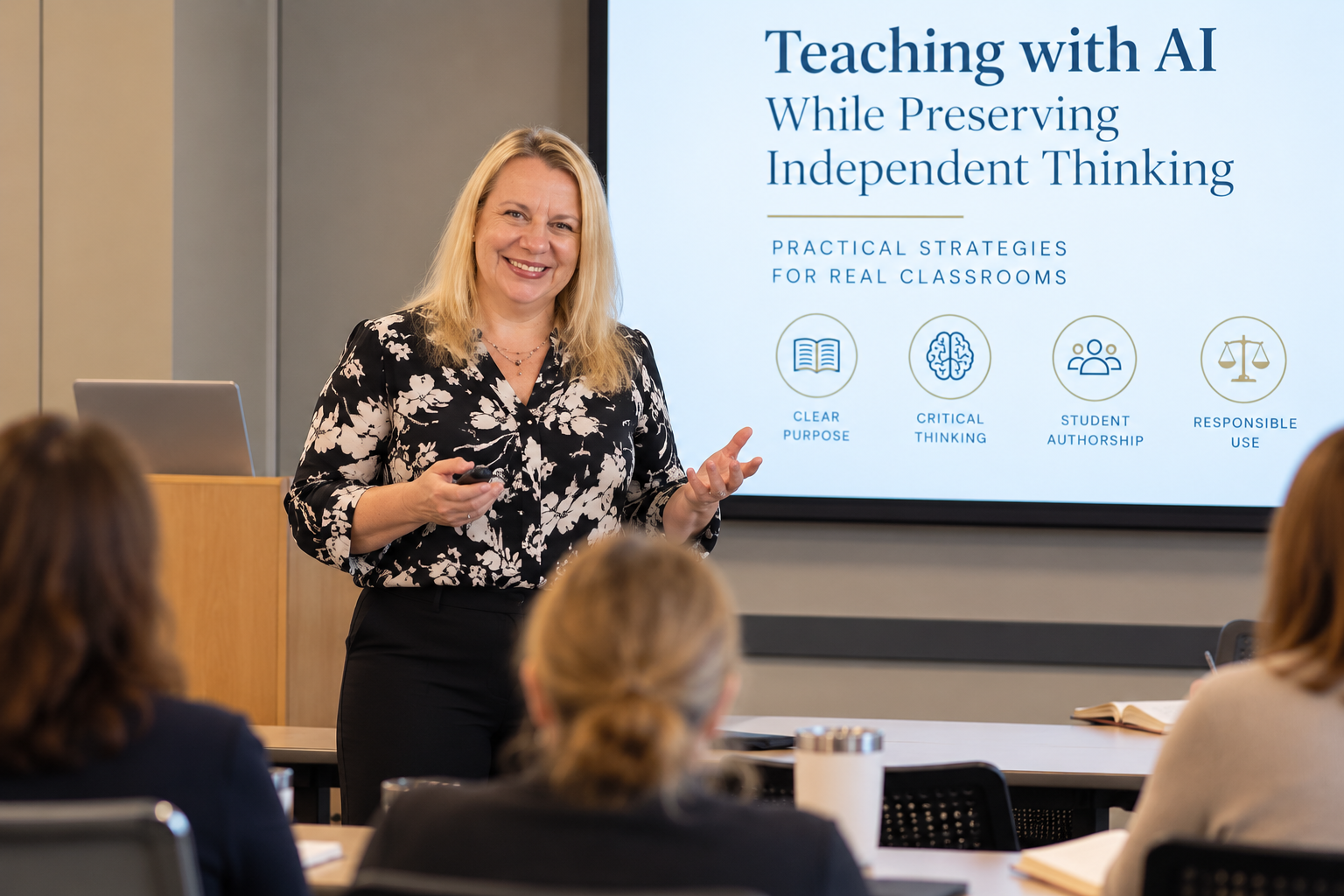
Teaching with AI While Preserving Independent Thinking
Explore how to decide when AI supports learning, when it interferes with learning, and how students can remain responsible for the thinking behind their work.
Educators leave with:
- A framework for evaluating appropriate AI use
- Strategies for preserving independent thinking
- Ways for students to explain and document AI use
- Practical classroom discussion prompts and policies
Writing, Research, and Academic Integrity in the Age of AI
Examine how writing and research assignments can be designed so that students use modern tools without surrendering authorship, evidence, verification, or intellectual responsibility.
Educators leave with:
- A redesigned writing or research assignment
- Source-verification activities
- Strategies for protecting student authorship
- Approaches to transparency and academic integrity
Practical AI for Educators
Learn useful, realistic ways to work with generative AI while keeping professional judgment at the center of planning, assessment, and instruction.
Educators leave with:
- Workflows for lesson and activity planning
- Approaches to rubric development
- Ways to adapt materials for different learners
- Strategies for checking AI-generated content
Curriculum and instructional support for schools and programs.
Professional learning does not always fit neatly into a single workshop. Schools and educational organizations may also need help thinking through curriculum, assignments, policies, or program design.
AI Integration
Clarify where generative AI belongs in a course or program, where it does not, and how expectations can be communicated clearly.
Curriculum Review
Review curriculum for rigor, clarity, alignment, student thinking, and opportunities for responsible technology use.
Assignment Design
Rethink writing, research, and project-based assignments in ways that preserve student ownership and intellectual work.
Faculty & Staff Learning
Develop focused professional learning around the questions and challenges most relevant to a particular faculty or school community.
Use the tools. Keep the thinking.
The goal is not to choose between traditional academic rigor and new technology. Educators need frameworks for using both well.
Generative AI can support teaching and learning, but judgment, evidence, authorship, discussion, and intellectual effort remain central.
Deanna Heikkinen, EdD
Deanna Heikkinen is an educator with approximately 20 years of experience in teaching, curriculum, and online course development. Her background includes college and K-12 education, academic writing, humanities, curriculum design, distance education, assessment, and educational leadership.
She has completed University of Glasgow coursework focused on generative AI in education, classroom use, ethics, and academic integrity.
Her professional learning approach combines practical technology use with a continuing emphasis on academic rigor, critical thinking, evidence, student authorship, and strong teaching.
Let’s talk about what your educators need.
Workshops and consulting can be shaped around the goals, audience, and instructional questions of your school or organization.